

Training and Capacity Building Agroecology approach: small ruminant management, Horticulture production, and Ecosystem restoration for cooperative members
- Introduction
Project proposal on “Agroecology for building resilience: Promote Livelihood Diversification through Climate Smart Agriculture and Ecosystem Restoration” aims to enhance the resilience of vulnerable farming communities in Lume Woreda and was approved and has been implemented as it is proposed.
Consensus meetings at the woreda level were carried out, project launches, and experience sharing from other cooperative have all been completed in order to start the project’s execution and it’s time to start the project. To achieve this, Development Agents (DAs) and cooperative members must receive capacity-building training on the agroecology approach.
As part of efforts to promote sustainable livelihoods and environmental resilience, training on agroecology approaches was organized for Development Agents (DAs) and cooperative members. It is known that local community (direct beneficiary of the project) was already organized into a cooperative in the name of “Siqe Ayyo” followed by kebele name. Accordingly, Siqe Ayyo Koka Nagawo, Siqe Ayyo Muda Sankalle, and Siqe Ayyo Ejere Walkite for three kebeles, respectively, fulfilled all legal requirements of a cooperative.
The training focused on enhancing knowledge and practical skills in horticulture production, ecosystem restoration, and small ruminant management and given based on the project agreement.
The training was attended by:
- Development Agents (DAs)
- Members of cooperative
- EBCCF staff
- Woreda expert and
- Kebeles expert
- Objectives of the Training
- To enhance participants’ understanding of agro–ecology principles and practices
- To build practical skills in sustainable horticulture, small ruminant management, and ecosystem conservation
- To promote diversified and climate-resilient livelihood options
- To improve natural resource management and ecosystem restoration
- To enhance productivity in small ruminant and horticulture production
- Key Training thematic areas
The training covered the following three major thematic areas:
-
- Small Ruminant Management
- Ecosystem Restoration
- Horticulture Production
- Small Ruminant Management
Training on small ruminant management was given for two kebeles (Muda Sankalle and Ejere Walkite). Small ruminant rearing is traditionally existed livelihood activity in the Muda Sankalle kebele, with poor management and feeding practices. To differ from the existing practice, sixty (60) participants were organized in the name of Siqe Ayyo Muda Sankalle, and DAs received awareness and skills training.
Fattening of small ruminants is a potential income-generating activity for Ejere Walkite community, as the area is surrounded by an agro-pastoral system and most beneficiaries of the project depend on preparing and selling of local alcohol, with the remaining of it used as feed for fattening. To differ from the existing practice, fifty (50) participants organized in the name of Siqe Ayyo Ejere Walkite received awareness and skills training.
Generally, the training was given on small ruminant rearing and fattening was focused on the following points:
- Improved feeding systems using locally available resources
- Animal health care and disease prevention
- Housing, breeding, and productivity improvement
- Integration of livestock with crop production systems
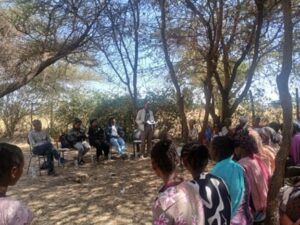
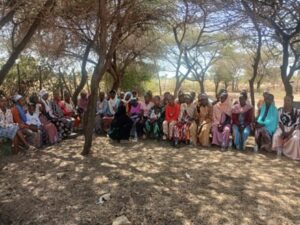
Figure: Participants from two kebeles (Muda Sankalle and Ejere Walkite)
Many questions and comments raised by participants focus on the:
- How many times to deworm and vaccinate sheep/goats?
- The identification of the most common diseases in their area and how they can be prevented
- The way to identify early signs of illness in small ruminants?
- Feed shortage is a major constraint, especially during drought periods.
- Market access is inconsistent, and prices fluctuate.
- Women play a major role in small ruminant management but lack support.
- Disease outbreaks cause significant losses.
Suggestions and Recommendations
Participants raised a number of questions and ideas that need reflection by both government stakeholders and the Forum. Accordingly, the points raised by the government and Forum are summarized as follows:
- Improve access to veterinary services and inputs.
- Provide continuous follow-up and technical support.
- Strengthen extension services and training programs.
- Support capacity building and practical training.
- Promote climate-resilient livestock practices.
- Encourage community-based resource management.
- Feed, health, and breeding are the main pillars of small ruminant productivity.
- Local solutions and indigenous knowledge should be integrated with modern practices.
- Collaboration among farmers, extension agents, and institutions is critical.
- Horticulture Production
Horticulture production plays a vital role in improving food security, nutrition, income generation, and livelihood diversification, especially for smallholder farmers. Recognizing its importance, a training program on horticulture production was conducted for Siqe Ayyo Koka Nagawo members and Development Agents (DAs). The training aimed to enhance participants’ knowledge, skills, and practical competencies in sustainable horticulture practices.
The training was organized as part of efforts to promote Agroecology for promoting livelihood diversification. It focused on improving the production and productivity of vegetables while ensuring environmental sustainability.
The overall objective of the training was to strengthen the capacity of participants in horticulture production. Specific objectives included:
- Enhancing knowledge of improved horticultural practices
- Promoting sustainable and climate smart production techniques
- Strengthening pest and disease management practices
- Encouraging efficient water use and irrigation methods
- Supporting livelihood diversification through horticulture
The training highlighted criteria for selecting suitable land, including soil type, water availability, and accessibility. Participants learned proper land preparation techniques such as plowing, leveling, and organic matter incorporation.
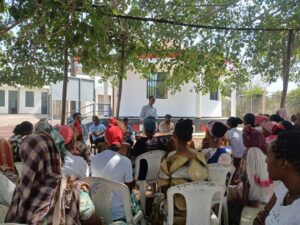
Figure: Picture taken during training program on horticulture production conducted for Siqe Ayyo Koka Nagawo
- Ecosystem Restoration
Ecosystem degradation, including soil erosion, deforestation, and loss of biodiversity, has become a major challenge affecting agricultural productivity and community livelihoods in many parts of Ethiopia. In response to these challenges, an ecosystem restoration training was conducted in three kebele (Koka Nagawo, Muda Sankalle, and Ejere Wolkite) of Lume Woreda.
The training took place from March 10–14, 2026, and brought together 170 participants, including Development Agents (DAs), community members, and representatives of cooperatives. The program aimed to strengthen participants’ capacity to restore degraded landscapes using sustainable and community-driven approaches.
The training combined theoretical sessions with experience sharing, enabling participants to better understand and apply ecosystem restoration practices in their local contexts.
3.3.1. Objectives of the Training
3.3.1.1. General Objective
The general objective of the training was to enhance participants’ knowledge and skills in ecosystem restoration for sustainable natural resource management and improved livelihoods.
- Specific Objectives
- To introduce key concepts and principles of ecosystem restoration
- To build skills in soil and water conservation techniques
- To promote the use of indigenous tree species
- To strengthen community participation and ownership
- To link restoration practices with livelihood improvement
Participants were introduced to the principles and importance of ecosystem restoration, focusing on rehabilitating degraded land and improving ecosystem services. Restoration includes:
- Site Selection and Planning: The training emphasized participatory planning approaches and criteria for selecting restoration sites, including land degradation level, soil condition, and community interest.
- Soil and Water Conservation Techniques
- Tree Planting
The importance of reforestation and vegetation cover was emphasized. Topics included:
- Selection of appropriate and indigenous tree species
- Planting techniques and spacing
- Protection and management of planted seedlings
- Integration of trees with crops (agroforestry)
- Conclusion
The training and capacity-building initiative successfully equipped DAs and cooperative members with essential knowledge and skills in agroecology. Continued support and expansion of these efforts will contribute to sustainable agricultural practices, improved livelihoods, and enhanced ecosystem restoration.