

The Environment, Biodiversity, and Climate Change Forum (EBCCF) convened a one-day validation workshop on Community Seed Bank (CSB) Key Performance Indicators (KPIs) on 29 December 2025 at the Pyramid Hotel and Resort, Bishoftu Town. The workshop brought together representatives from community seed banks, relevant government institutions, and technical experts with the objective of reviewing, validating, and enriching the draft guiding manual on CSB KPIs.
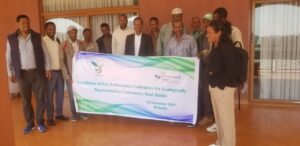
The workshop officially commenced with a welcome address and introduction to the program schedule delivered by Dr. Dejene Teressa, who outlined the purpose of the meeting, the expected outcomes, and the importance of developing standardized KPIs to strengthen the performance, monitoring, and sustainability of community seed banks in Ethiopia.
Following the introduction, Dr. Girma Balcha, Executive Director of EBCCF, delivered the opening remarks. In his address, Dr. Girma emphasized the strategic importance of community seed banks in conserving farmers’ seed systems through on-farm (in situ) conservation approaches, particularly in the context of climate change, biodiversity loss, and increasing pressure on local genetic resources. He highlighted that, to date, more than 53 community seed banks have been established across the country, playing a critical role in safeguarding indigenous crop diversity and enhancing farmers’ seed security. However, he underscored that the absence of clearly defined and harmonized key performance indicators has limited the ability of stakeholders to systematically monitor performance, assess impact, and provide targeted technical and institutional support. He noted that the draft guiding manual under validation is intended to fill this gap by providing a practical framework for monitoring, evaluation, and learning for CSBs and their partners.
The technical review session followed, during which the draft document was formally presented and reviewed by Mr. Nesiru Temam and Dr. Girma Eshetu. The reviewers provided in-depth, constructive comments focusing on the clarity of indicators, methodological consistency, alignment with national biodiversity and seed policies, and practical applicability at the community level. Their feedback also addressed issues related to institutional roles, data collection mechanisms, and the use of KPIs for adaptive management and reporting.
Subsequently, an open plenary discussion was held, allowing participants from community seed banks, the Environmental Protection Authority, and other relevant institutions to share their observations, experiences, and suggestions. Participants emphasized the need for context-specific indicators, capacity-building support for CSB management committees, and integration of gender, youth participation, and climate resilience considerations into the KPI framework.
In the final session, the EBCCF technical team responded to the comments and questions raised by reviewers and participants. The team acknowledged the relevance and value of the feedback provided and reached a consensus to incorporate most of the proposed comments and suggestions into the revised version of the manual. The workshop concluded with a shared understanding that the validated KPI guiding document will significantly enhance the effectiveness, accountability, and long-term sustainability of community seed banks in Ethiopia.